UGC Creator Platforms vs Direct Sourcing
Each platform tier offers different trade-offs between speed and control.

A UGC creator platform is, at its core, a marketplace with operational infrastructure bolted on: creator discovery, brief distribution, contracting, payments, rights management, and sometimes performance tracking, all in one system. The pitch is speed and process compression. Insense advertises creator applications within 48 hours and deliverables in roughly 14 days. Billo delivers within five to seven days at flat rates starting at $99 per video. For a brand that needs creative assets yesterday, that's a compelling proposition. But speed has a way of flattening the conversation about what you're actually trading away to get it.
"Platform" isn't one thing, and the distinctions matter more than most sourcing conversations acknowledge.
Self-service marketplaces like Billo and Trend.io run a simple model: post a brief, creators apply, brand selects. Fast throughput, minimal oversight, limited recourse when content misses. Managed network platforms like Insense and Aspire layer in broader vetting, campaign tracking, and whitelisting support. Enterprise tools like Cohley add rights management, DAM integration, and managed service options where the platform team handles creator communication entirely. CRM-style platforms like Grin and CreatorIQ are built for ongoing programs at scale: relationship management, payment automation, performance analytics. Each tier has meaningfully different capabilities, and confusing them is how brands end up frustrated by a tool that was never designed for their actual problem.
What platforms categorically fail to provide: strategic judgment on creator fit, guaranteed creative quality, or meaningful recourse at the self-service tier when content misses the brief. The brand still has to know what good looks like. Platforms offload operational friction, not creative discernment.
One consistently underestimated differentiator is usage rights. Platforms that bake licensing and whitelisting into their standard contract flow eliminate a negotiation burden that derails direct sourcing at scale, particularly for Spark Ads and Meta partnership ad formats, where specific creator permissions have to be in place before a campaign can even launch. That sounds like a minor workflow detail until you've watched a launch window close while you're still chasing a creator's signed addendum. I've seen it happen more than once. At volume, that operational bottleneck becomes a real constraint, and how it compares to what direct sourcing costs is exactly the question worth thinking through.
What Direct Sourcing Actually Involves, the Full Operational Picture
Direct sourcing means the brand, or its agency, finds, vets, contracts, briefs, pays, and manages creators without a platform in between. Discovery runs through organic TikTok and Instagram search, hashtag mining, inbound creator DMs, referrals from existing creator relationships, and talent agencies for higher-tier partnerships. The channels are accessible. The operational surface area, though, is wide enough to surprise teams who've only ever modeled it on a spreadsheet.
Take vetting alone. Audience quality checks, FTC compliance history review, competitor conflict screening, content archive audits: brands using multiple tools average around three per creator during this phase. Multiply that across fifty creators and you have a significant internal workload before a single brief has gone out.
Then contracting. Every creator negotiation covers usage rights, exclusivity windows, revision terms, and repurposing permissions individually, with no standardized flow. Once content is in production, approvals and revision cycles are managed manually. A substantial share of brand-creator disputes trace back to vague or missing content guidelines, and in direct sourcing the brand owns that problem entirely.
Payment is where the gaps become visible in the most inconvenient ways. A significant share of creators cite payment delays as their top frustration with brand partnerships, and creator communities talk. A brand with a reputation for slow payment finds its creator options narrowing quietly, without any obvious moment when it happened. By the time you notice, the damage is already compounding.
None of this means direct sourcing is wrong. It means it carries real costs that don't appear on the per-video invoice. The upside is real: relationship depth that compounds over time, full flexibility on terms, no platform margin embedded in creator fees, creative collaboration that can evolve into something differentiated. But the question isn't whether direct sourcing is better. It's whether your infrastructure and bandwidth can absorb the operational load before quality starts degrading.
Creator Vetting Is Where the Sourcing Model Choice Has the Highest Stakes
Vetting is more complex than it appears from outside a program, and it's where the sourcing model decision carries its most consequential trade-offs. It's also worth naming something that rarely gets said plainly: most brands systematically underestimate how much of their vetting process is intuition dressed up as process.
Follower count, despite its intuitive appeal as a proxy for reach, ranked last as a selection factor in creator suitability research, chosen by roughly 8% of brands and 7% of agencies. Brand fit ranked first, at 22% for both. That single finding should reorient how you think about discovery. The creator with the most followers is frequently not the creator whose audience is actually interested in your product category.
Audience quality is the hidden risk beneath reach metrics. A creator with 80,000 followers and a 6% engagement rate can still carry a substantially bot-inflated audience. Influencer fraud costs brands more than a billion dollars annually worldwide, and fake followers affect nearly a third of Instagram accounts claiming 100,000 or more followers, per Influencer Marketing Hub's 2025 data. Platforms don't automatically solve this. Self-service marketplaces do minimal audience quality auditing; enterprise tools run deeper checks. The rigor varies enormously by tier, and assuming the platform has handled it is how brands end up with fraudulent impressions and no clear recourse.
Hard disqualifiers that any vetting process must catch, regardless of sourcing model: documented FTC disclosure violations, archived brand-unsafe content, active concurrent sponsorships with direct competitors, verified patterns of contract non-compliance. Missing any of these at discovery creates legal and reputational exposure that no content asset justifies.
There's one dimension of vetting that brands routinely underweight, and it cuts against a convenient assumption. In 2025, nearly 78% of creators turned down at least one brand deal, per TikTok and BSI's Creator Suitability research. Vetting runs both directions. Creators with strong, engaged audiences have options, and they are increasingly discerning about how they use them. Brands that show up with unclear briefs, unrealistic timelines, or reflexive micromanagement of creative execution get rejected by precisely the creators they most want. That dynamic is independent of sourcing model, but it means vetting capability is a legitimate input to the decision, not just a downstream operational concern.
How Program Maturity Should Drive the Sourcing Decision
Treating the platform-versus-direct choice as a permanent decision made at program inception is the error I see most consistently. Programs evolve. The sourcing infrastructure should evolve with them, and it rarely does fast enough.
Early-stage brands running their first creator program benefit from platforms in a specific and concrete way: they reduce the cost of learning. No need to build contracting templates from scratch, establish payment rails, or develop vetting workflows before you've validated a single piece of content. The brief-and-receive model is appropriate when the priority is learning what works, not optimizing a system you haven't tested yet. Speed of learning matters more than cost efficiency at this stage, and platforms are well suited to providing it.
Scaling brands with validated creative direction are in a materially different position. They know which creator profile converts. They can brief precisely. They benefit from negotiating long-term relationships rather than paying per-video platform margins, because the value of a productive creator compounds over time in ways a transactional arrangement rarely captures. This is where a structured roster model starts to make sense: a small ambassador tier on formal long-term contracts for depth and sustained brand trust; a retainer roster generating consistent monthly output; a campaign pool activated for specific launches and replenished regularly. Platforms can still efficiently serve that campaign pool tier. The sourcing model doesn't have to be binary, and framing it that way is usually what causes brands to make a worse choice.
Two failure modes recur. Brands that plateau at platform-only sourcing tend to miss the relationship depth that produces well-integrated creative. Brands that jump to full direct sourcing too early drown in operational overhead before content volume justifies it. Program maturity should be the diagnostic, not aspiration about what the program will eventually become.
Volume Requirements and the Operational Math Behind Each Model
Expect roughly 3% to 5% of seeded creators to produce content that actually drives sales on TikTok Shop. A hundred-plus monthly creator seeding program isn't aggressive; it's the arithmetic of the channel. The volume target is embedded in the expected conversion rate, and that math has real operational consequences that are easy to underestimate when you're planning rather than executing.
Discovery, contracting, payment processing, revision cycles: each is a small task, but multiplied across a hundred creators per month they aggregate into a workload that surprises teams who modeled it abstractly. Platforms compress that cost per creator meaningfully. With average spend per UGC creator at $177.68 and content costs down 44% year-over-year per Collabstr's 2025 data, the per-video economics increasingly favor platform use for volume production.
Direct sourcing at high volume without dedicated infrastructure produces predictable outcomes. Payment delays accumulate. Brief compliance degrades as manual management stretches thin. Quality control becomes reactive rather than preventive. Platforms built for volume, with networks of tens of thousands of creators and campaign automation infrastructure, can absorb throughput that would require multiple internal hires to replicate directly.
Where the math shifts is when a brand needs highly customized creative. Platform rosters trend toward proven, high-converting formats because that's what their creator communities have been rewarded for producing. Direct sourcing gives more latitude to brief unconventional approaches or test new content formats before they become platform norms. If your creative strategy depends on being ahead of the format curve rather than executing it efficiently, that flexibility has real value the per-video cost comparison doesn't capture.
For most programs with serious scale ambitions, the practical answer is a hybrid structure: platforms handling the high-volume base layer of paid ad creative testing and product seeding, direct sourcing handling the ambassador tier and performance creators with documented track records.
Operational Control, Creative Ownership, and What Brands Give Up on Each Path
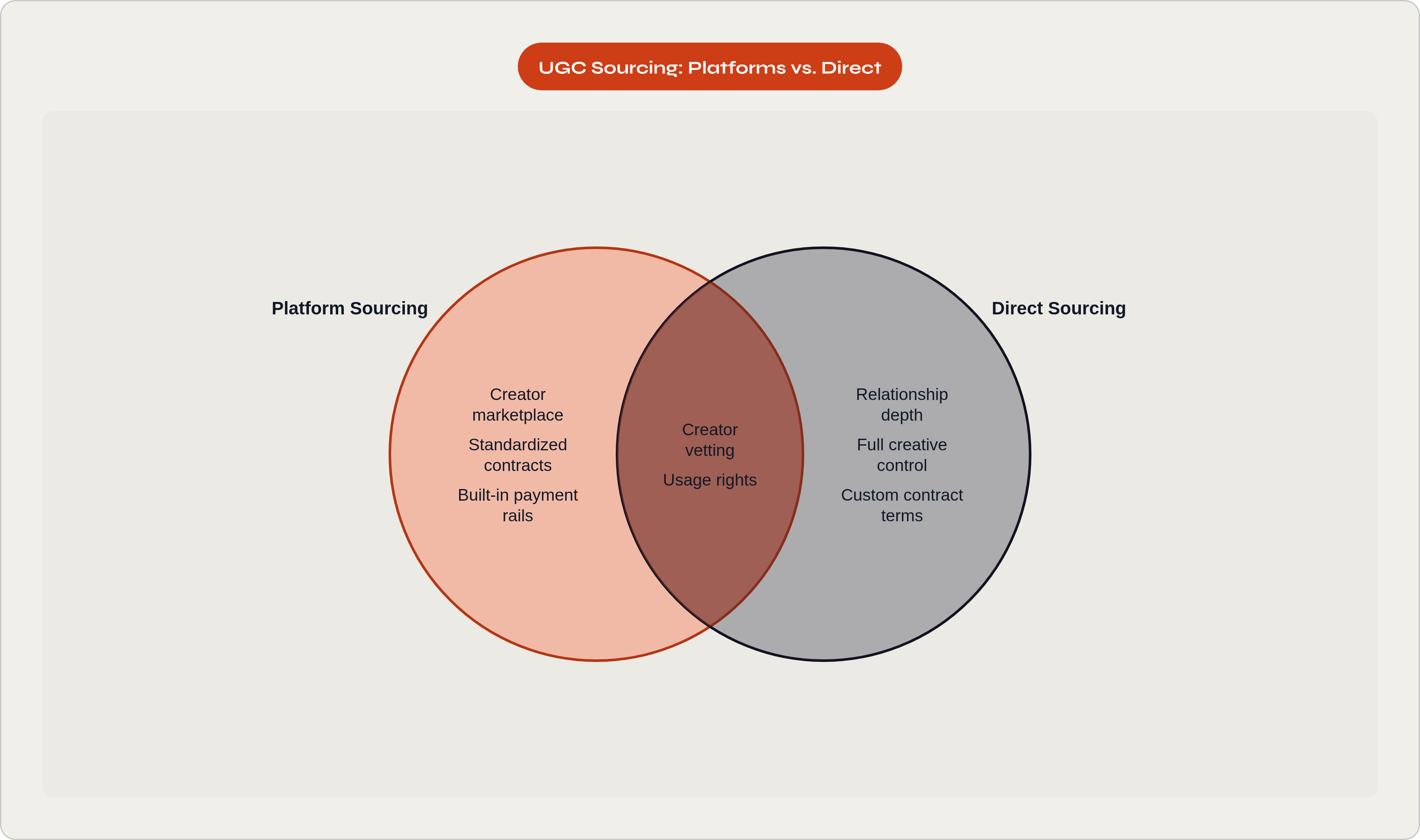
The platform model's control trade-offs are worth being direct about. Brief compliance is enforced by platform workflow, which is useful, but creative output is bounded by what the platform's creator pool knows how to produce. Usage rights are standardized, easier to execute and less flexible to negotiate. Analytics are platform-reported and rarely integrate cleanly with existing measurement infrastructure. Creator relationships are mediated, which means the brand never fully owns the relationship and limits the long-term leverage that comes from sustained partnership.
Direct sourcing inverts most of this. Full ownership of the creator relationship enables creative evolution over time rather than a series of transactional deliverables. Contracts can be structured across every dimension that matters for sophisticated programs: exclusivity windows, repurposing permissions, whitelisting rights, revision terms. Creators who choose ongoing brand partnerships over one-off posts produce more integrated content, and consumer research consistently shows that roughly half of consumers expect sponsored content to feel authentic. Long-term creator relationships are structurally better positioned to deliver that than platform-mediated single engagements.
The repurposing question is where this gets operationally serious and often catches brands off guard. Whitelisting, Spark Ads, Meta partnership ads: this is where UGC content generates its highest return, and it's where the licensing question stops being administrative and becomes strategically significant. Platforms that bake these permissions into their standard contract flow close a gap that direct sourcing must solve through individual negotiation. Creators are increasingly protective of how their content is repurposed. That negotiation is nontrivial at scale, and direct sourcing puts it squarely on the brand, every time, with no standardized template to fall back on.
Where you invest operational resources determines which trade is worth making. Platforms trade granular control for speed and process efficiency. Direct sourcing trades speed for depth, flexibility, and compounding relationship value. Neither is categorically superior. The brand's specific situation, not a general preference for one model, should determine which exchange is worth making.
Applying the Framework: Matching Sourcing Model to Brand Situation
Three questions do most of the work.
Where is the program in its maturity? What volume does it actually need, and does the internal infrastructure exist to support it at that volume? How much creative control and relationship depth does the brand need to achieve its specific goals? Those three questions, answered squarely rather than aspirationally, narrow the decision considerably.
Platform-first makes sense when the brand is testing UGC for the first time and needs to learn what works before investing in long-term relationships. It makes sense when volume is high and internal ops capacity is constrained, when speed-to-asset is the primary bottleneck, and when the brand lacks established contracting and payment infrastructure. In these scenarios, the platform is doing real operational work, not just providing a convenient shortcut that a capable internal team can easily replicate.
Direct sourcing makes sense when the brand has validated creative direction and knows which creator profiles actually convert. It makes sense when ambassador-level relationships are the goal: long-term, exclusive, well-integrated. It makes sense when creative customization exceeds what a platform's creator pool reliably delivers, and when the brand has, or is actively building, the internal operations to manage contracting, payments, and quality control without degradation over time.
Hybrid is the realistic answer for most scaling brands. Platforms handle the volume and discovery layer; direct sourcing handles the top-tier relationship layer, and agencies like Pebble, a data-driven creator marketing agency that runs high-volume, creator-led organic campaigns on TikTok and Instagram for consumer brands, are built to manage exactly that split on a brand's behalf. This structure also de-risks the program: no single sourcing failure, whether a platform outage or a creator relationship breaking down, collapses the content pipeline entirely.
The sourcing model is not a permanent decision, and brands that treat it as one eventually find themselves running a program architected for a stage they've long since outgrown. The ones that manage it well revisit the question periodically, as volume needs shift, internal capabilities grow, and creative strategy evolves. The right sourcing model isn't the one that looked best on paper at launch. It's the one that fits what the program actually is right now.