Replicating a Viral UGC Video After Initial Success
Isolate the hook, format, and emotional elements that worked instead of chasing lightning.

The most seductive misread is also the most natural one: the creator's personality did it, or the product sold itself, or the whole thing was lightning in a bottle. These explanations feel true because they're not entirely wrong. But I've watched brand teams spend months chasing that feeling, and the thing about "lightning in a bottle" as a diagnosis is that it's explicitly a theory of helplessness. You can't act on it.
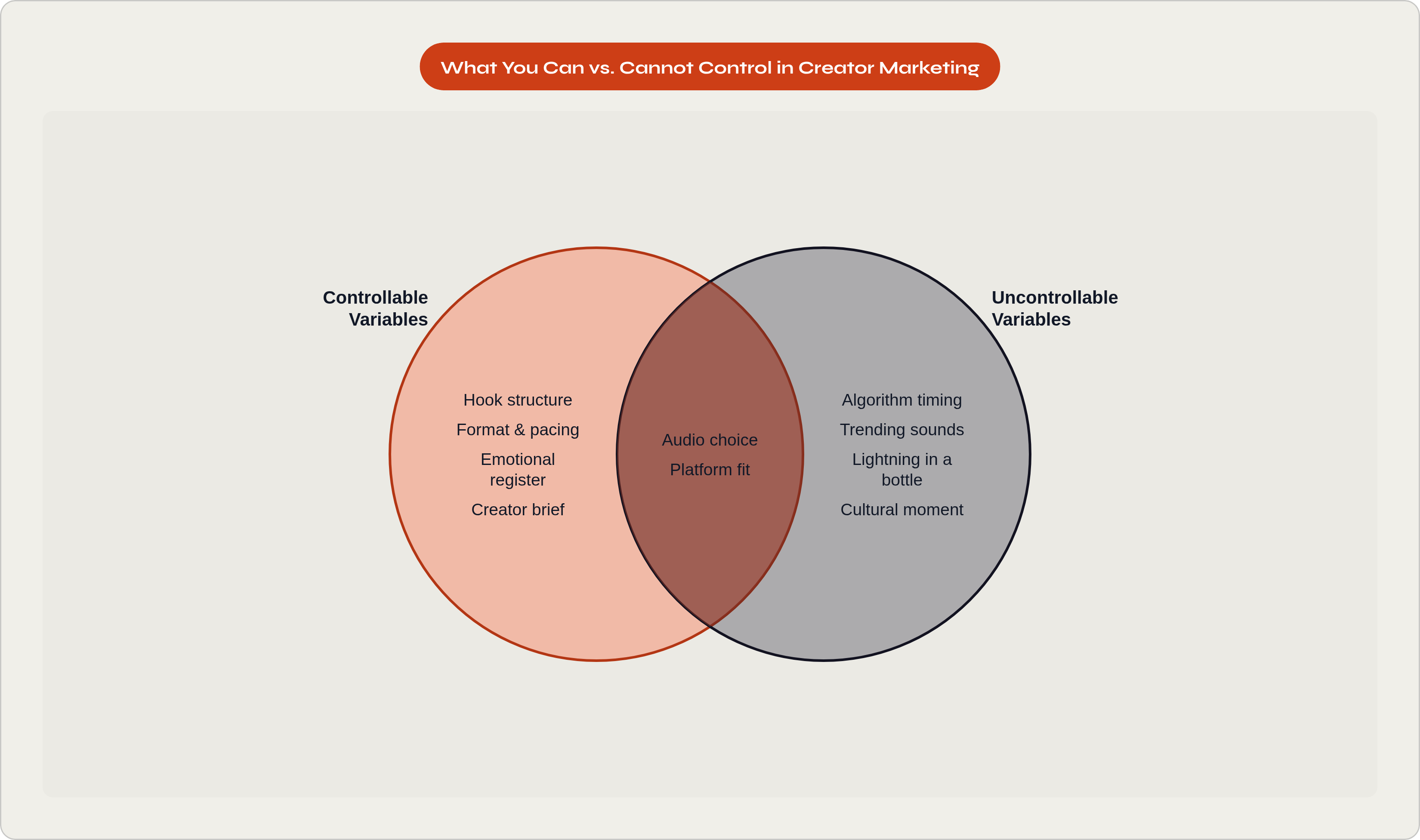
So start smaller. Start with the first three seconds. Did the video open with a physical reaction, a counterintuitive claim, a problem stated so precisely it felt like someone had read the viewer's diary? Hook structure is one of the highest-leverage creative variables in short-form video, and it's almost entirely reconstructible. Then look at format: length, pacing, whether it was a talking head, a demo, a reaction, a challenge. Look at the audio, because whether that was a trending sound or original voiceover carries real algorithmic weight that most brand teams treat as an afterthought. Look at the emotional register, not as a vibe assessment but as a brief input. Was it funny? Relatable? Quietly surprising? Those aren't soft descriptors; they're specific creative decisions someone made, which means someone else can make them again.
Then there's the variable brands almost never account for: platform timing. Algorithms reward content that aligns with what's already surging, popular sounds, trending formats, content categories in ascent. The same video posted two weeks later, after a sound has peaked or a format has saturated, will land in a completely different environment. Timing is real and it matters and you cannot systematically engineer it. Which is precisely why the framework has to isolate what you can control and build around that, rather than trying to reverse-engineer a moment that was partially just good luck.
Pull the native analytics before you draw any conclusions. Watch-time curve, traffic sources, share-to-save ratio. View count tells you the video spread; those numbers tell you whether anyone cared. But what if the numbers look strong across the board — does that mean you've cracked the formula? Not quite. It means you have a hypothesis worth testing.
Building a Creative Autopsy: The Questions to Answer Before Producing Another Video
"Autopsy" is the right word because it implies rigor rather than speculation. I've sat in a lot of post-campaign debriefs where the consensus was "it felt authentic," and I can tell you that "it felt authentic" is not a brief. It's a eulogy for a moment you don't understand.
The questions need to be specific enough to produce answers that can actually be handed to a creator. Which moment in the video drove the highest watch-time retention, and what was happening there? Where did viewers drop off, and what does that reveal about pacing? What was the share-to-view ratio, and does that number suggest the video hit something visceral enough that people wanted to pass it along? What did the comments say, not the volume but the content, because comment language is often the most honest signal you'll get about what the audience actually connected with, frequently in phrasing the brand would never generate on its own.
Then the harder question: was the performance anchored to the creator's delivery, their physical setting, or the product demonstration itself? Those three anchors require completely different replication strategies, and confusing one for another is where most second-attempt videos go quietly wrong.
What you're building out of this is a short document: the specific hook type, the format structure, the emotional beat that correlated with performance. That document is the input for the next production cycle. What you're resisting is the pull toward over-indexing on surface aesthetics, chasing a sound that already peaked, copying the setting without understanding why it worked. The structural elements travel across contexts. The surface-level aesthetics are often just relics of a particular moment, and reproducing them signals "we watched the video" rather than "we understood it."
The output of this step is a working hypothesis. Not a formula. That distinction sets the right expectation for what comes next.
How to Brief Creators to Test the Hypothesis at Scale
The goal here is explicitly not to clone the original video. Cloning produces a lower-fidelity version of a moment that has already passed; the audience has often already seen the format, and what felt fresh the first time now reads as derivative. The goal is to test whether the isolated variables perform across different creators, different contexts, slight format variations. You're not validating; you're learning.
A measurable brief at this stage defines a hook type, not just a topic. "Open with a counterintuitive claim about the product" is a hook type. "Talk about our moisturizer" is not a brief. It defines a format constraint: something like 15 to 30 seconds, no cuts in the first five seconds. It names an emotional register: relatable frustration resolved by the product. And it clearly delineates what the creator must keep versus what they own.
That last piece matters more than most brands want to admit. Creators who have real latitude over how they carry an idea produce content that feels native to the platform in a way that scripted execution rarely does. The authenticity isn't a soft preference; it's the mechanism by which the content gets treated by the algorithm and the audience as something that belongs there. One might argue that tighter brand control produces more consistent messaging — but consistent messaging and effective messaging are not the same thing, and on algorithmic platforms, the latter depends heavily on the former yielding some ground.
On volume: top-performing programs test dozens of creative variants weekly. Most brands wait two weeks for a single video. That gap is not primarily a budget problem. It's a systems problem. For brands not yet operating at scale, briefing five to ten creators on the same hypothesis with deliberately varied formats is a practical entry point. It generates enough comparative signal to be useful without overwhelming production capacity, and it starts building the data set the framework actually runs on.
Which Creators to Bring Back, and Which New Ones to Add
The original creator is an obvious starting point. They demonstrated something that worked. But I've seen programs that became so dependent on a single creator that when that person shifted their content direction, or just got busy, the whole effort stalled. The program needs to be more than one creator deep.
Before re-engaging the original, try to name precisely what made them work. Their niche? Their delivery style? The specific audience demographics? Their willingness to improvise within a brief rather than execute it literally? Once you can name the trait, you can source for it, which is a more durable strategy than loyalty to a single voice.
The follower-count trap is persistent. Reach feels like the obvious proxy for impact because the numbers are visible and simple to compare. But in algorithmic feeds, content drives discovery more than audience size does, and a creator with 40,000 highly engaged followers in a relevant category will frequently outperform a creator with 400,000 diffuse followers in a loose brand adjacency. Micro-influencers in the 10,000 to 100,000 follower range consistently drive higher conversion rates and cost a fraction per post, which means a fixed budget can buy creative volume and genuine audience testing rather than one high-stakes placement that delivers uncertain results.
When vetting new creators, engagement rate above three percent on the relevant platform matters. So does audience demographic alignment with the brand's actual buyer profile, not just a vague content category match. Tools like Meta's Creator Marketplace surface partnership history, which gives you real signal on whether a creator can execute a brand brief or whether they're more naturally suited to organic posting and go stiff when handed a deliverable.
Engagement fraud is underestimated as a risk. Campaigns without fraud protection have recorded fraudulent engagement in the double digits. Fake engagement doesn't just waste spend; it corrupts the data the creative framework is built on, which means the next cycle gets briefed on false signals and produces worse outcomes that are genuinely difficult to diagnose. That raises an important question: if your measurement infrastructure can't distinguish real engagement from manufactured engagement, what exactly are you optimizing toward?
The KPIs That Tell You Whether a Replicated Video Is Actually Working
The first failure mode in replication attempts is declaring success or failure based on view counts. Views move fast, they're visible, they feel meaningful. They are also the metric least connected to whether anything commercial happened.
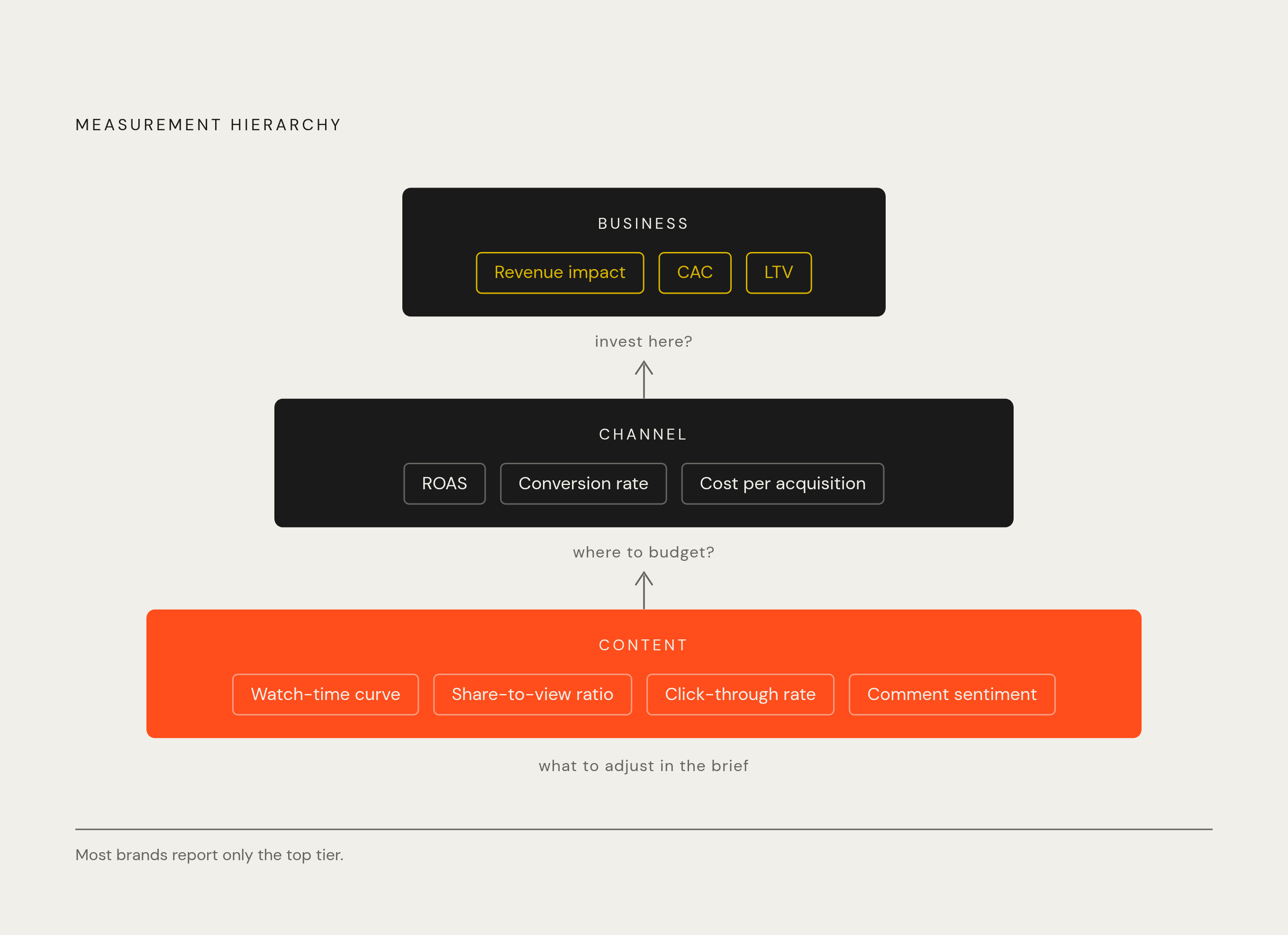
The right hierarchy starts at the business level: is the channel driving revenue, lowering customer acquisition cost, improving lifetime value? Below that, channel-level: ROAS, conversion rate, cost per acquisition from creator-sourced traffic. Below that, content-level: watch-time curve, share-to-view ratio, click-through rate, comment sentiment. Each layer informs the one above it. Content-level signals tell you what to adjust in the brief; channel-level signals tell you where to put budget; business-level signals tell you whether the channel deserves continued investment at all.
The most important signal in the replication phase is not whether one video hit. It's whether a creator is sustaining engagement and driving conversions across multiple posts within a 30-day window. That's the signal for repeatability, which is what the framework is actually trying to build toward.
Attribution is unglamorous but non-negotiable. UTM codes per creator, per post. A seven-to-fourteen day attribution window, because purchase decisions in most categories don't happen in the first 24 hours. A comparison against a control group, so you can separate content-driven lift from background demand. Without the control group, you're reading noise as signal and building strategy on top of it.
The output of this measurement cycle is a ranked view of which hypothesis variants outperformed, which creative elements correlated with conversion rather than just engagement, and which creators drove repeatable results. That ranked view becomes the brief for the next cycle.
Turning Organic UGC Wins Into Paid Assets to Extend Their Reach
Organic reach has a ceiling, and it arrives faster than brands expect. The videos that clear the conversion thresholds from the measurement cycle deserve a paid runway. Spending behind unvalidated creative wastes budget and, more damagingly, corrupts the signal you spent time generating.
To understand why this works, we must first look at the mechanism of whitelisting. Instead of running the ad from the brand's account, you run it through the creator's account. It appears in the feed as the creator's post, not a branded advertisement, which preserves the trust signal that made the original content work. That distinction is not cosmetic. It materially affects reception, particularly in categories where audiences have become attuned to the gap between a genuine recommendation and a sponsored placement. I've watched the same creative asset underperform as a brand ad and overperform as a whitelisted creator post. The content was identical. The source changed everything.
Paid amplification of creator content is one of the fastest-growing segments of creator spend. Importantly, the largest portion of that growth is not new creator partnerships; it's extending validated existing content into paid channels. The sequencing matters: test organically, validate against conversion KPIs, then amplify. Running it backward, paying to amplify content before you know if it converts, is a common and expensive mistake.
One operational detail brands consistently handle too late: whitelisting requires explicit creator authorization, built into the original contract. Retroactive permission requests create friction, delay the amplification window, and occasionally collapse the deal entirely. This is an administrative detail that belongs in the briefing phase, not the deployment phase.
How the Framework Compounds, and What Prevents Most Brands From Getting There
Here is the part that's hardest to hold onto when a replication attempt underperforms the original: the value of the framework is not in any single video. It's in what the system learns across cycles.
Each production cycle feeds better briefs. Each measurement cycle surfaces higher-performing creator profiles and eliminates weaker hypotheses. Each paid amplification cycle generates revenue that funds the next round of testing. The program gets cheaper and more precise over time, not because the team gets lucky again, but because it has accumulated information that makes each subsequent cycle less speculative. But how does this affect our original promise — that you can reverse-engineer a viral moment? It doesn't, exactly. What compounds is not the ability to manufacture virality, but the ability to make virality matter less, because the system performs even when no single video breaks out.
What breaks the loop in practice is almost never a shortage of creative talent. It's production bottlenecks that prevent enough variants from being tested to generate real signal. It's measurement gaps, no UTM discipline, no attribution window, no control group, which produce conclusions that can't be trusted and briefs that compound errors rather than insights. It's operational drag, contracts and payments and creator communication consuming the team capacity that should go toward analysis. And most corrosively, it's the organizational impulse to declare the framework a failure after one replication attempt that doesn't match the original's numbers, which is a bit like concluding that A/B testing doesn't work because the first test wasn't conclusive.
The brands running successful programs at scale treat creator marketing as a performance channel with its own optimization rhythm, not a campaign with a launch date and an end date, agencies like Pebble, a data-driven TikTok and Instagram creator agency that runs high-volume, creator-led organic campaigns for consumer brands and apps, are built specifically to operate inside that rhythm. The programs driving real, sustained growth are not running on viral moments. They're running on systems that convert each moment of organic traction into a more refined hypothesis for the next one. Getting there requires patience, and a tolerance for cycles that don't perform, and a willingness to trust the data over the intuition that the next video just needs to feel more like the original. It usually doesn't.